How Cosmic Inks Creates Its Graphic Tee Prints
A graphic can look perfect on a laptop screen and still look completely different once it becomes a T-shirt.
That difference is easy to overlook.
A design file can have the right colours, sharp artwork and a composition that looks balanced on screen. But a T-shirt is not a digital canvas. Once the artwork has to live on fabric, its size, placement, proportions and the silhouette of the garment all start to matter.
A back graphic that looks impressive as an image can feel too small on an oversized T-shirt. A design that works perfectly in a square file may need a different visual balance once it is placed across the back of a garment.
This is where the custom graphic T-shirt design process becomes more than simply putting artwork onto a blank T-shirt.
At Cosmic Inks, a custom graphic tee starts with the design itself. A customer provides the artwork or graphic idea, Cosmic Inks creates a garment mockup to show how that design can look on the T-shirt, the customer reviews it, and only after approval does the design move into production.
The printing machine is part of the story.
It just isn’t where the story starts.
A Graphic Tee Starts With the Design, Not the Print
When you look at a finished graphic T-shirt, it is easy to separate it into two things: the garment and the artwork.
But the two have to work together.
A graphic is designed in a particular shape and proportion. A T-shirt has its own shape, seams, silhouette and visual space. When those two meet, the way the design is perceived can change.
This becomes even more noticeable with oversized streetwear.
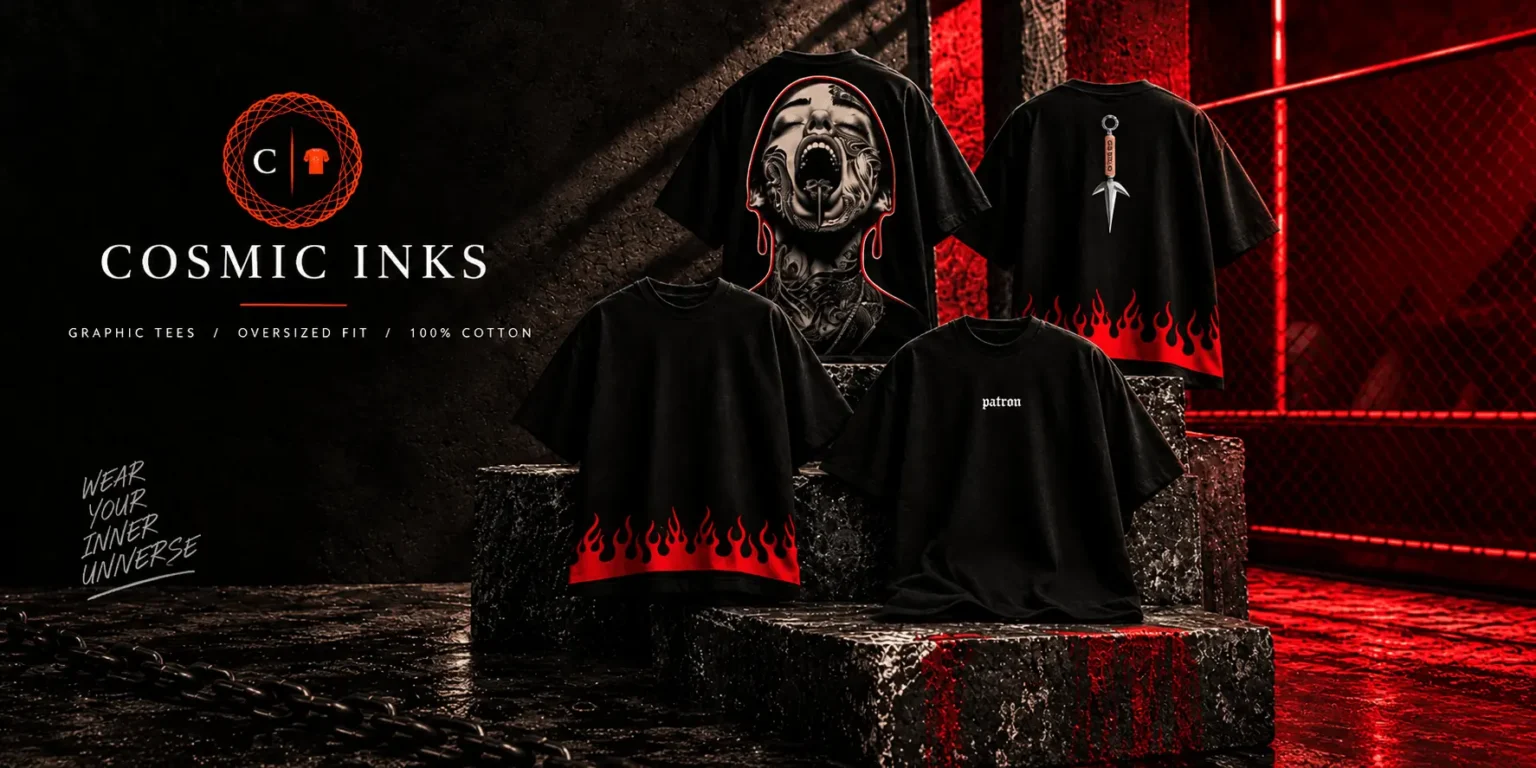
An oversized T-shirt gives a graphic more room to exist. A back print can become the main visual feature of the garment, while a front graphic can influence the entire balance of the tee.
So the question is not simply:
“Can this design be printed?”
There is another question that matters just as much:
“How should this design look once it is actually on the T-shirt?”
That is the thinking behind Cosmic Inks’ design-to-print approach.
The artwork is considered in the context of the garment instead of being treated as a finished product the moment the digital file is ready.
And that distinction becomes particularly important when the customer is providing their own design.
From a Design File to Something You Can Actually Wear
Imagine a customer approaches Cosmic Inks with a graphic they have already created.
The artwork itself may already be finished.
The colours are selected. The illustration is complete. The typography is in place.
But there is still one important step before that artwork becomes a physical T-shirt:
seeing how it works on the garment.
This is where the custom T-shirt mockup becomes useful.
Cosmic Inks takes the customer’s design and creates a mockup showing how the graphic can appear on the T-shirt.
Suddenly, the artwork is no longer sitting inside a design program.
The customer can start looking at it as a garment.
Is the graphic large enough?
Does the placement feel right?
Does the artwork work with the oversized silhouette?
Does the overall composition look balanced when there is fabric surrounding the graphic?
These questions are difficult to answer when you are only looking at an isolated PNG or design file.
A mockup creates that missing context.
It gives the customer a visual representation of what the design is intended to look like once it becomes a T-shirt.
That is an important part of the custom graphic T-shirt design process because the customer is able to understand the proposed garment before the design moves into production.
The Mockup Is Where the Customer Gets to See the Idea Take Shape
There is a simple reason the mockup matters.
A customer should not have to imagine everything from a design file.
Suppose someone has created a detailed back graphic for an oversized T-shirt. As a standalone image, the artwork might look exactly right. But once it is placed on a garment, the scale and position can change how the entire design feels.
The mockup bridges that gap.
Cosmic Inks shares the proposed design presentation with the customer so they can review the direction before production.
The process therefore becomes:
Design → Mockup → Customer Review → Approval
That small middle stage changes the experience.
Instead of the artwork disappearing into production immediately, there is a visible point where the customer can actually see what is being proposed.
The customer knows what the intended garment should look like before the printing stage begins.
That is especially valuable in custom apparel because the final purchase is not an image.
It is a physical T-shirt.
Why Customer Approval Comes Before Printing
This is one of the most important parts of the Cosmic Inks custom workflow.
Once the mockup has been created, it is shared with the customer for review.
Only after the customer approves the design does it move towards production.
That means the custom process isn’t simply:
Send artwork → Print → Ship
There is another step in between:
Send artwork → Mockup → Review → Approval → Print → Delivery
That approval stage gives the customer a reference point.
They can look at the design in the context of the T-shirt rather than judging the artwork only as a standalone digital file.
It also makes the process easier to understand.
The customer knows:
- what design is being used
- how the graphic is intended to appear
- what the garment direction looks like
- that production happens after approval
For a buyer ordering custom clothing online, that visibility matters.
Custom orders can feel uncertain when everything happens behind the scenes. The mockup makes one important part of that process visible.
It gives the customer a chance to see the idea before it becomes the final garment.
The Garment Matters as Much as the Graphic
There is another part of the design story that can easily get ignored:
the T-shirt itself.
A graphic doesn’t exist independently once it has been printed.
The fabric, weight and silhouette become part of the final visual experience.
Cosmic Inks’ standard oversized T-shirts use 240 GSM French Terry fabric with an oversized relaxed fit.
GSM stands for grams per square metre. It is a measurement commonly used to describe the weight of fabric.
It is useful because fabric weight can give buyers an idea of how substantial a garment is likely to feel, although GSM alone does not determine overall quality.
For an oversized streetwear T-shirt, a heavier fabric can contribute to a more structured and substantial feel.
That is why 240 GSM works with the direction Cosmic Inks uses for its oversized T-shirts.
The point isn’t simply that “higher GSM is better.”
It is about choosing a fabric weight that makes sense for the intended garment.
A graphic designed for an oversized streetwear piece is ultimately being placed on a particular silhouette. The fabric helps create that silhouette, and the graphic has to work with it.
So the print design process isn’t completely separate from the garment.
The artwork and the T-shirt have to make sense together.
Why Cosmic Inks Offers Different GSM Options for Custom Orders
Not every custom T-shirt needs to have the same weight.
A customer creating a lightweight everyday tee may want something different from someone creating a heavier oversized streetwear piece.
For custom requirements, Cosmic Inks can work with different fabric weights, including:
| GSM | General Feel | Potential Use |
|---|---|---|
| 180 GSM | Lighter | Lightweight custom T-shirts |
| 220 GSM | Medium | Balanced everyday garments |
| 240 GSM | Heavier and more structured | Oversized streetwear look |
| 260 GSM | Heavier | More substantial custom garments |
The important thing is not to treat these numbers as a simple quality ladder.
A 260 GSM T-shirt isn’t automatically better than a 180 GSM T-shirt.
They serve different purposes.
For someone who wants a lighter garment, 180 GSM may make more sense. A 220 GSM option offers a little more substance. The 240 GSM option aligns particularly well with the structured oversized direction used by Cosmic Inks. And 260 GSM gives customers the option of going heavier for a more substantial garment.
Climate can also influence the decision.
India’s weather is not the same throughout the year or across every region, so the ideal fabric weight can depend on how and where the T-shirt is going to be worn.
For custom apparel, the better question is therefore not:
“What is the highest GSM?”
It is:
“What fabric weight makes sense for the T-shirt I am trying to create?”
From Approved Mockup to DTF Printing
Once the customer has reviewed and approved the mockup, the design can move into production.
This is where the printing stage begins.
Cosmic Inks uses DTF printing for its graphic prints.
DTF stands for Direct-to-Film.
At a basic level, the graphic is prepared digitally and printed onto a special film. The design is then transferred from the film onto the T-shirt using heat.
For a buyer, the important thing to understand is where DTF fits into the overall process.
It is not the beginning.
It is the stage where the approved graphic is transferred onto the physical garment.
The journey looks something like this:
Digital Artwork → Garment Mockup → Customer Approval → DTF Printing → Finished T-Shirt
The artwork has moved from a screen to a garment.
And that transition is why the earlier steps matter.
The design has already been considered in relation to the T-shirt. The customer has already seen the proposed direction. The garment weight has already formed part of the physical product.
The print is the point where all of that becomes tangible.
What Actually Separates a Brand From a Print-and-Ship Experience?
This is where the difference becomes easier to understand.
Printing itself isn’t unusual.
A graphic can be printed onto a T-shirt by many different businesses.
The more interesting question is:
What happens before the printing?
A basic transactional experience can look like:
Artwork → Print → Shipment
Cosmic Inks’ custom workflow adds a design visualisation and approval stage:
Customer Design → Mockup → Customer Review → Approval → DTF Printing → Finished Garment → Delivery
The difference isn’t that Cosmic Inks has invented printing.
The difference is the attention given to the design before it reaches the printer.
The customer gets to see the artwork placed into the context of the garment.
That matters because a graphic T-shirt is a visual product.
The artwork is important.
Its scale is important.
Its placement is important.
The garment silhouette is important.
And the fabric contributes to how the whole piece feels.
When all of these things come together, the result is more than a graphic that happens to be printed on a T-shirt.
It becomes a designed garment.
That is a more useful way to think about the streetwear brand design story India is beginning to see more of: not simply who can print graphics, but how a brand approaches the process of turning visual ideas into something wearable.
A Look Inside the Cosmic Inks Custom T-Shirt Process
For a customer, the entire journey can be broken down into six simple stages.
01 The Design Comes In
The customer provides the artwork or graphic idea they want to use.
This is where the process begins.
The design can already exist as artwork; what matters next is understanding how it can translate onto the garment.
02 Cosmic Inks Creates the Mockup
The artwork is placed into a garment mockup.
This gives the customer a visual representation of how the graphic can appear on the T-shirt.
Instead of looking at an isolated design file, the customer can now see the artwork in relation to the garment.
03 The Customer Reviews It
The mockup is shared with the customer.
This is the point where the proposed placement and overall visual direction can be considered before production.
04 The Design Gets Approved
Once the customer approves the mockup, the design moves forward.
This is the point where the concept becomes ready for production.
05 The Approved Graphic Is Printed
Cosmic Inks uses DTF printing to transfer the approved graphic onto the T-shirt.
The design that started as digital artwork now becomes a physical print.
06 The Finished Garment Is Delivered
After production, the completed custom T-shirt is prepared and delivered to the customer.
The journey is simple:
Design → Mockup → Review → Approval → DTF Print → Delivery
But the simplicity of the final process hides the important part: the design gets a chance to exist as a garment before it becomes a final print.
Why This Matters When You’re Buying Custom Apparel
When someone orders a custom T-shirt, they are not really buying a design file.
They are buying the result of turning that design into a physical garment.
That is why questions naturally come up:
Will my design actually look right on the T-shirt?
How large will the graphic appear?
What fabric weight should I choose?
What happens after I send my artwork?
Will I see the design before it is printed?
These questions become particularly relevant when buying custom apparel online.
The Cosmic Inks process addresses them through different stages.
The mockup gives the customer a visual reference.
The approval stage gives the customer a chance to review that direction before production.
The GSM options give customers flexibility when the custom garment requires a different fabric weight.
And DTF printing is the production method used to bring the approved graphic onto the garment.
None of these steps needs to be complicated.
What matters is that the customer can understand them.
That transparency is important because custom clothing is ultimately about taking someone’s idea and turning it into something physical.
The Design-to-Print Journey, Without the Mystery
A lot happens between the moment a graphic exists on a screen and the moment that graphic becomes a T-shirt.
At Cosmic Inks, that journey can be understood without making it unnecessarily complicated:
First, there is the design.
Then comes the mockup, where the artwork is considered as part of the garment.
Then comes customer review and approval.
After approval, the design moves into DTF printing.
And finally, the completed garment is delivered.
The process isn’t about adding unnecessary steps.
It is about making the important steps visible.
For a customer, that means there is a clear point between submitting artwork and receiving a finished T-shirt.
And for a design-led streetwear brand, that point matters.
Because the difference between a digital graphic and a graphic tee isn’t the printer alone.
It is everything that happens while the design is being turned into something wearable.
Frequently Asked Questions About the Cosmic Inks Custom Graphic T-Shirt Process
Yes. Customers can provide their own artwork or graphic idea for a custom T-shirt. The design can then be visualised as a garment mockup before production.
Yes. Cosmic Inks creates and shares a mockup for customer review before the design moves into production.
A mockup helps you see how a standalone design may look when placed on an actual T-shirt. It provides context for the graphic’s scale, placement and relationship with the garment.
The process starts when a customer provides a design or graphic idea. Cosmic Inks creates a mockup showing how the design can appear on the T-shirt. The customer reviews and approves the mockup, after which the approved design moves into DTF printing and production.
Cosmic Inks can work with 180 GSM, 220 GSM, 240 GSM and 260 GSM fabric options for custom requirements.
Cosmic Inks’ standard oversized T-shirts use 240 GSM French Terry fabric with an oversized relaxed fit.
DTF stands for Direct-to-Film printing. The graphic is digitally prepared and printed onto a special film before being transferred onto the garment using heat.
The Graphic Is Only the Beginning
A finished graphic tee can look simple when you see it hanging on a rack.
You see the artwork.
You see the T-shirt.
You see the final print.
What you don’t immediately see is everything that happened between the design file and the finished garment.
At Cosmic Inks, that journey starts with the artwork but doesn’t end there.
The design is first considered on the garment through a mockup. The customer gets to review the proposed direction before production. Fabric weight can be selected according to the custom requirement, from lighter 180 GSM and 220 GSM options to the standard 240 GSM direction or a heavier 260 GSM option. Once approved, the graphic moves into DTF printing and eventually becomes the finished T-shirt.
That is the part of a graphic tee that usually remains invisible.
The final print may be what catches your eye, but the decisions made before printing are what turn the artwork into a garment.
And for Cosmic Inks, that’s where the story behind the design really begins.